
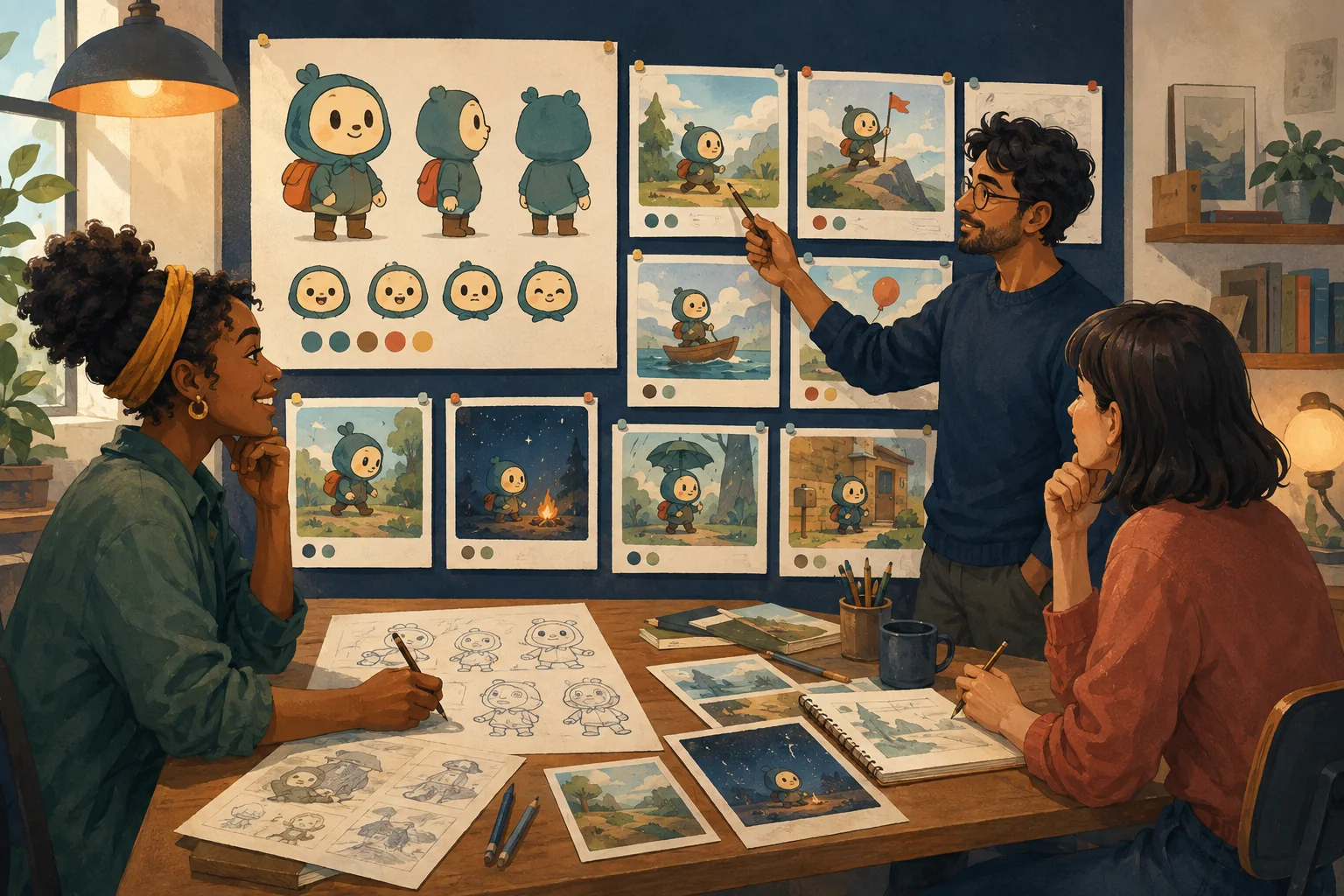
A short cartoon is not simply a long cartoon with most of it removed.
The idea itself should fit the format.
For a very short video, one situation is usually enough.
Start late
Instead of:
Tom wakes up, gets dressed, eats breakfast, leaves home, drives to work and discovers his office is empty.
Start:
Tom enters the office carrying coffee. Every desk is empty. He slowly checks his phone. It is Sunday.
The setup is already inside the scene.
Make the first image understandable
On a phone, the viewer should quickly recognize:
- character;
- situation;
- important object.
Do not begin with a visually confusing wide shot if the joke depends on a tiny detail.
Use one main beat
A short cartoon can be:
- setup → payoff;
- question → answer;
- mistake → consequence;
- expectation → reversal;
- problem → solution.
Do not force three subplots into 30 seconds.
Keep dialogue lean
Every sentence consumes time.
If a look can replace a line, use the look.
If text on a phone screen can replace an explanation, show the phone.
Compose vertically
For 9:16:
- keep important faces readable;
- avoid placing characters too far apart;
- protect caption space;
- keep critical action away from interface-heavy edges.
A horizontal master may need a dedicated vertical version.
Let the ending land
Do not cut the instant the payoff happens.
A short reaction can make the ending readable.
Then end.
Do not explain the joke.
Build recurring formats
If the character will appear in many shorts, create a repeatable premise.
For example:
"Milo Misunderstands Humans."
Every episode begins with Milo interpreting one ordinary human behavior incorrectly.
Now you have a content format rather than one isolated idea.
Where MyToonMaker fits
Short-form cartoons still benefit from the same underlying production logic: stable characters, planned shots and connected scenes.
At publication time, Codex should verify current vertical output/export support and link this article to the appropriate creator workflow.
Make a Short Cartoon.